Coco Chanel’s Big Idea: From the Roaring 20’s to the New Millenium
- Erica Lim
- Sep 28, 2023
- 3 min read

Table of Content
The Big Idea in Marketing
Introducing the Little Black Dress
Breaking Down David Ogilvy’s Five Criteria
Every marketer’s dream is to come up with the big idea that lands them their breakthrough campaign, sends their brand to new heights of success, and raises a level of advantage beyond their competitors. As discussed in advertising and IMC, a big idea is bold and creative, it builds on strategy, and it ties product benefit with consumer desire whilst persuading the audience in a way that is fresh and involving. Ogilvy came up with a five point checklist to help identify a big idea. (We will be exploring this in detail later in the blog!)
“It takes a big idea to attract the attention of consumers and get them to buy your product”
- David Ogilvy
In an industry as big as fashion, it is often a struggle to come up with ideas that actually last. It’s difficult today because there is a constant need for newness and trends. Ideas don’t stick. It was difficult back then because in the early days of fashion, there wasn’t much room for creativity or innovation. Instead, there were rules and status quo.
We’re tracing it to before the 1920s when wearing black was reserved only for mourning, and wearing it anytime else would be inappropriate. This probably sounds bizarre, as I’m sure black is a staple in most if not all of our closets.

Coco Chanel had an idea. A big idea. And that was none other than the Little Black Dress (LBD).
In 1926, Coco Chanel printed a short simple black dress on the cover of Vogue magazine. American Vogue called it “Chanel’s Ford” and predicted that it would become “a sort of uniform for all women of taste,” which is exactly what happened. Let’s circle back to Ogilvy’s five point checklist:
1. Did it make me gasp when I first saw it?
Me, personally? Maybe not. (I am a Gen Z and 85% of my clothes are black). For the women in the 1920s? Absolutely. The LBD marked a significant moment of liberation as it broke free the restrictive, traditional clothing of the century before.
2. Do I wish I had thought of it myself?
Of course. By the 1930s, the LBD had become incredibly popular and remained so during the Great Depression. The LBD is easily one of the most influential garments in fashion history and its simplicity meant that any woman could afford to be chic.
“Thanks to me, they [non-wealthy] can walk around like millionaires."
- Chanel
3. Is it unique?
The uniqueness lies in it being a blank canvas for us to explore. There are a million ways that the LBD can be worn and there is no other colour with the same ability or versatility.
4. Does it fit the strategy to perfection?
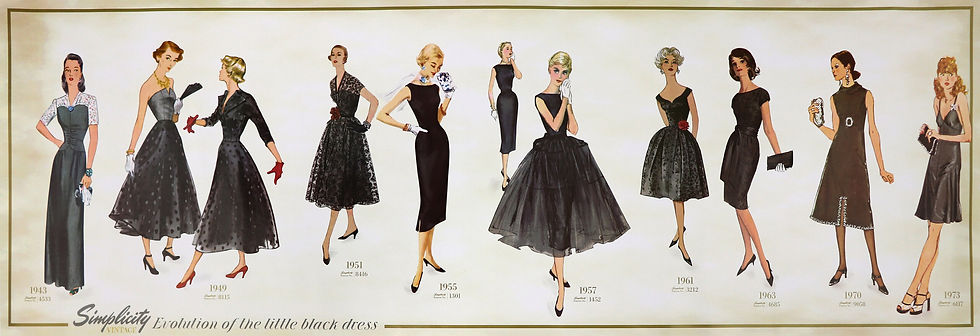
Chanel revolutionized fashion when the LBD first hit the big screen in 1926. In the cover, the LBD was accessorized with pearls and heels to make it appear more elegant. In 1961, Audrey Hepburn wore it in “Breakfast at Tiffany’s” which was the most perfect portrayal of the LBD.

5. Could it be used for 30 years?
What started as a dropped-waist flapper dress has since been adopted and altered into so many variations and styles. And it still is to this day! It is the one quintessential piece in every woman’s closet and has been for over 90 years. The LBD is timeless, it attracted the attention of consumers, and most importantly, it stuck.
Coco Chanel's Little Black Dress and its cover of Vogue was a big idea not because it was an invention, but because it opened the door to new possibilities and opportunities. In the fashion world, it welcomed new creations and ventures in playing with accessories and style. More importantly, it was significant as it was a democratisation and modernisation of women's clothing.


Comments